 EldenRingInsight
In the vast, intricate tapestry of Elden Ring's lore, where entire schools of magic are devoted to the moon and fate is written in the stars, one celestial body remains conspicuously absent from the narrative spotlight: the sun. This is a striking departure not only from FromSoftware's own legacy—where Solaire of Astora's sun-worshipping joy became a cultural touchstone of the Dark Souls series—but also from countless real-world mythologies that place a radiant sun deity at the center of creation. The Lands Between are illuminated by the colossal, golden Erdtree, its light so pervasive that it seemingly overshadows the very sun in the sky, casting long shadows over the sun's historical and mystical significance. A question posed by the community has ignited a fascinating debate: in a world brimming with cosmic lore, why does the sun itself seem to have been forgotten?
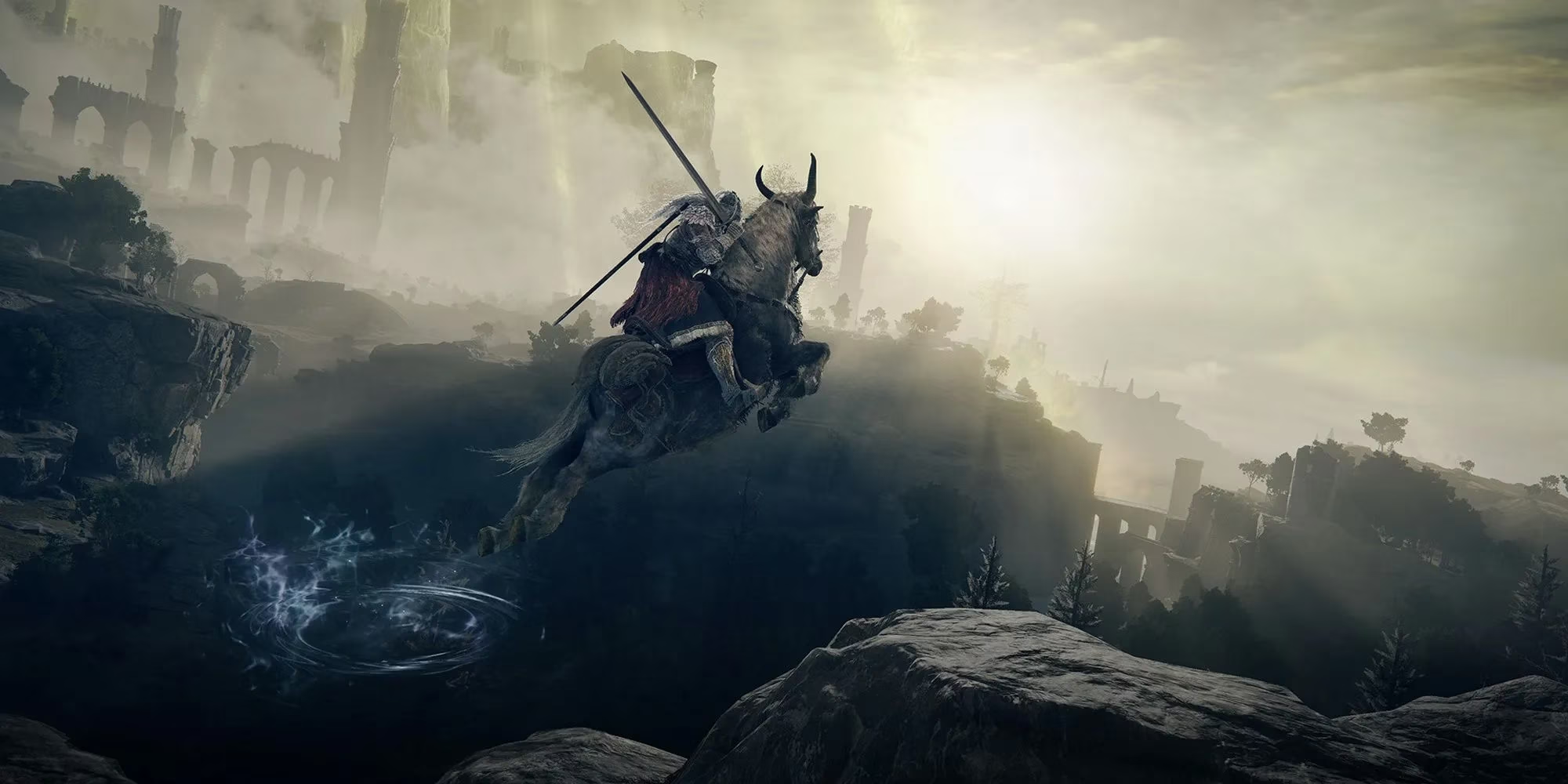
The most prevalent theory, eloquently put forth by lore enthusiasts, centers on the Erdtree's theological and literal usurpation of the sun's role. The Erdtree isn't merely a tree; it is the source of grace, the axis mundi of the world, and the focal point of the Golden Order's faith. Its light is not just sunlight—it is holy light, the manifestation of divine will. Why worship a distant, impersonal sun when a tangible, golden monument showers its blessings directly upon the land? The Erdtree's dominance suggests a deliberate cosmological shift: 💫
-
The Erdtree as the New Sun: It provides light, life, and spiritual guidance.
-
Symbolic Replacement: The Golden Order's ideology may have subsumed or erased older solar cults.
-
A Literal Dimmming: The tree's radiance might physically obscure the sun's presence in the sky.
This eclipse of solar importance doesn't mean the sun has vanished without a trace. Scattered, enigmatic references persist, like faded glyphs from a lost age. The loathsome Dung Eater, a figure obsessed with cursing all life into his twisted vision of equality, wears a prominent sun medallion on his armor. This is never explicitly explained, leading to compelling interpretations. Perhaps, for the Dung Eater, the sun symbolizes a personal guiding light—a horrific, cursed sun that justifies his path of defilement. He follows "his own sun," a dark parody of Solaire's quest for his "very own sun." It's a chilling inversion of the sun's typical symbolism of hope and order.
Far to the north, in the frozen, haunting reaches of the Mountaintops of the Giants, lies Castle Sol. Here, the sun's legacy is tied to tragedy and failed resurrection. A spectral soldier recounts how the empyrean Miquella, in his desperate attempt to grant his slain half-brother Godwyn a true death, sought to conjure an eclipse—a moment where sun and moon align. This "eclipse of the sun" was meant to be a sacred ritual, a tool of celestial power to heal Godwyn's soulless death. Its failure underscores a key theme: the sun's old power is still recognized, but the knowledge to wield it is lost or broken. The castle's name itself, "Sol," stands as a lonely monument to this forgotten potential.
Further evidence of a bygone solar era can be found in the Sun Realm Shield. Its description is a poignant piece of world-building: "The Seat of the Sun is long faded away." This single line hints at a profound history:
| Artifact | Lore Implication |
|---|---|
| Sun Realm Shield | Proof of an ancient civilization that worshipped the sun. |
| Castle Sol | A site where solar/eclipse magic was studied for high-level ritual. |
| Dung Eater's Medallion | The sun's symbol repurposed for a personal, corrupt ideology. |
These fragments paint a picture of a great "Sun Realm," a civilization predating the Erdtree's total dominance. What happened to it? Was it conquered, assimilated by the Golden Order, or did it fall for other reasons? The answers are buried, much like Godwyn's body beneath the Erdtree's roots. Speaking of Godwyn, his connection to the sun's absence is a critical thread. His death, half-bodied and infecting the land with Deathroot, represents a corruption of the Golden Order's fundamental principles. The sun, often a symbol of life and order, may have been conceptually "killed" or dimmed by this primal wound to the world.
As of 2026, the community's gaze is fixed on the future, specifically the anticipated Shadow of the Erdtree expansion. The haunting teaser imagery—the Erdtree seemingly blighted and choked—directly ties to Godwyn's legacy of Deathroot. Lore theorists like Govlum_1996 speculate that delving deeper into the mystery of Godwyn's death and the roots of the Golden Order's corruption may finally shed light on the sun's faded seat. Will we learn of the Sun Realm? Will the ritual of the eclipse be revisited? The expansion promises to explore the Erdtree's shadows, and in those shadows, the lost light of the sun may finally be rediscovered. While fans recently grappled with the performance nuances of the ray-tracing update, the deeper quest for understanding Elden Ring's world continues. The story of the sun is a story of displacement, forgotten power, and the cryptic history that lies just beneath the surface of the golden light—a compelling mystery waiting for its dawn.
Comments